
Mail
yangtao@jx-aiyi.com
How to Choose the Right Flammable Storage Safety Cabinet: Standards, Specifications & Buyer’s Guide
Author:JIANGXI AIYI HI-TECH CO., LTD.
Click:
Time:2026-08-19 11:49:30
1. Introduction: Why Selecting the Correct Safety Cabinet Matters
In high-risk industrial environments, research laboratories, and manufacturing facilities, storing volatile and flammable liquids is an everyday necessity. However, storing hazardous materials on unapproved open shelving presents extreme risks of accidental fires, toxic vapor accumulation, and chemical explosions.
A specialized Flammable Storage Safety Cabinet is specifically engineered to limit internal temperature rise during an external fire, isolating flammable fuels and giving workers vital time to evacuate. Choosing the correct cabinet requires a clear understanding of international safety regulations, chemical compatibility, and key mechanical specs.
2. Regulatory Compliance Standards You Must Know
When evaluating commercial safety cabinets, strict compliance with recognized fire safety and environmental standards is paramount:
- OSHA 29 CFR 1910.106 (US Occupational Safety & Health Administration): Governs federal workplace rules regarding maximum allowable quantities (MAQ) for flammable liquid storage, spill containment, and warning sign requirements.
- NFPA Code 30 (National Fire Protection Association): Defines fire protection criteria. Compliant cabinets must pass a 10-minute fire resistance test where internal temperatures remain below 325°F (162.7°C).
- European Certification (EN 14470-1, CE, RoHS): For European or global operations, EN 14470-1 certification rates safety cabinets (Type 30, Type 60, or Type 90) based on furnace fire tests measuring how long internal temperatures remain safe. CE and RoHS compliance confirm chemical and environmental safety.
- ISO System Management: Leading safety cabinets are manufactured under ISO Quality, Environmental, and Health & Safety Management Systems (ISO 9001/14001/45001) and undergo continuous annual third-party fire and explosion-proof testing.
3. Engineering Specifications & Key Safety Features
To ensure maximum protection against thermal and explosive hazards, look for these key structural features
Feature | Specification | Safety Function |
Double-Wall Construction | Premium 1.0mm cold-rolled steel (~1.2mm powder-coated) with a 38mm insulated air gap | Insulates cabinet interior from external fire heat. |
3-Point Linkage Lock | Mechanical double lock with zinc-alloy latch & 180° double doors | Seals doors tightly to block flame entry; supports dual-key 'two-person, two-lock' management. |
Leak-Proof Spill Sump | 50mm high liquid-tight containment sill | Prevents accidental chemical spills from overflowing into the workplace. |
Heavy-Duty Shelving | 2 adjustable galvanized steel shelves (≥130 kg load capacity per shelf) | Corrosion-resistant, high-capacity support for heavy drums and bottles. |
Dual Vents & Flame Arrestors | Dual vent openings with anti-fire mesh flame arrestors | Safely vents hazardous volatile fumes without allowing external ignition into the unit. |
Static Grounding | Dedicated OSHA static grounding connector | Dissipates static electricity to prevent sparks during liquid transfer. |
4.Additional Structural Highlights:
- Spot-Welded (Rivet-Free) Frame: Enhances structural rigidity and extends fire resistance lifespan.
- Epoxy Powder Coating: Interior and exterior surfaces are coated with epoxy resin for high corrosion and rust resistance.
- Explosion Relief Design: Incorporates structural pressure relief functions to prevent fragmentation or dangerous shrapnel ejection in extreme situations.
5. Step-by-Step Selection Guide for Facilities:
Classify Your Chemicals & Select the Color Code:
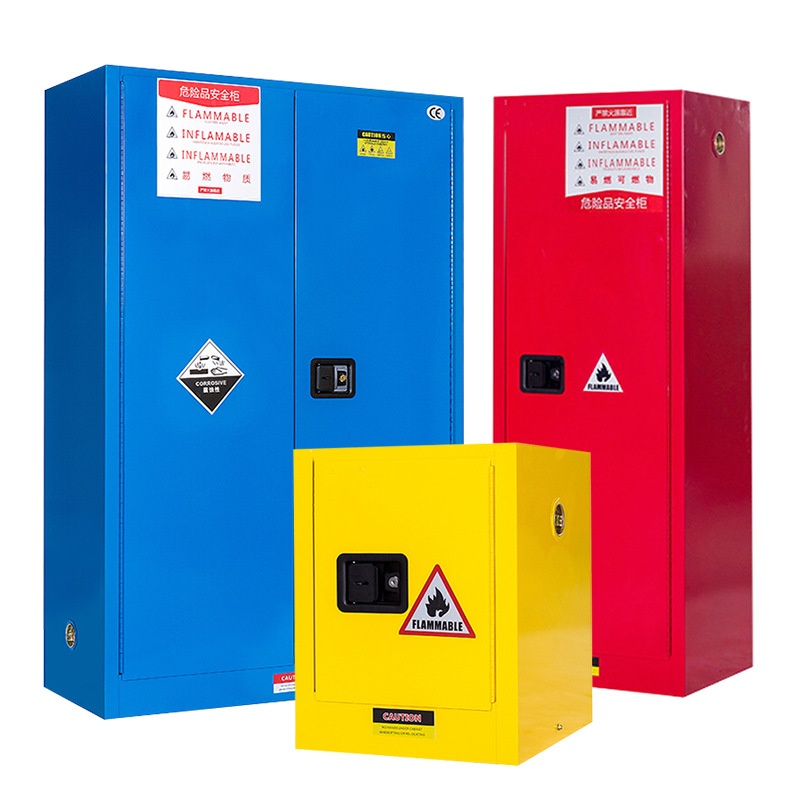
- Yellow Cabinets: Designed for flammable liquids (e.g., solvents, gasoline, alcohols).
- Red Cabinets: Designed for combustible liquids (e.g., paints, inks, lubricants).
- Blue Cabinets: Designed for corrosive liquids and mild acids/bases.
- Calculate Storage Capacity & Door Specs: Ensure you stay within the OSHA limit of 60 gallons for Class I/II flammables per fire area unless additional suppression systems exist.
- Verify Ventilation and Grounding Setup: Check that your installation area supports grounding wires to connect to the cabinet's static terminal. If local codes require external exhaust, connect to the built-in dual vents with flame arrestors.
Recommended article
—


Recommended Products
—

AY-601Q Fully Automatic Transformer Oil Analysis Gas Chromatograph
The AY-601Q Fully Automatic Transformer Oil Analysis Gas Chromatograph is a next-generation dissolved gas analysis (DGA) system designed specifically for electric power applications. Integrating mechanical oscillation degassing, gas chromatography detection, automation control, and intelligent analysis, it completes the analysis of hydrogen, methane, ethylene, ethane, acetylene, carbon monoxide, carbon dioxide, and other gas components within 7 minutes per sample injection,with a 15-position aut
Interview

MS10-H500-Pro LCD Digital Magnetic Hotplate Stirrer
The MS10-H500-Pro is a high-performance LCD digital magnetic hotplate stirrer featuring a 10-inch glass ceramic work plate that handles up to 30L of liquid with powerful magnetic stirring. With digital speed control from 100-1500rpm, heating up to 500°C, PT1000 external temperature sensor support (±0.2°C accuracy), a “HOT” safety warning, and real-time SD card data recording, it delivers precise, safe, and traceable heating and stirring for modern laboratories.
Interview

Frozen Animal Semen Filling & Sealing machine
This automatic frozen semen straw filling and sealing machine integrates automatic counting, quantitative filling, and ultrasonic welding into one streamlined workflow. With a filling efficiency of approximately 2,000 straws per hour, touch-screen control, and real-time process monitoring, it minimizes manual intervention and supports standardized batch production—making it the ideal solution for animal breeding stations, breeding laboratories, and frozen semen production lines.
Interview

AY-GCX-624 Medium polarity GC column
The 6% Cyanopropylphenyl-94% Dimethylpolysiloxane GC Column is a high-performance medium-polarity chromatographic column designed for gas chromatography (GC) applications. It offers exceptional versatility, robustness, and sensitivity, making it ideal for a wide range of analytical tasks across industries such as pharmaceuticals, environmental monitoring, petrochemicals, and cosmetics.
Interview

EX-1800 High-Performance HPLC System
This high-performance liquid chromatograph (HPLC) is a high-precision, high-stability analytical device designed for high-demand liquid phase separation analysis in laboratories. It is equipped with a 70MPa ultra-high pressure infusion pump, providing a flow rate range of 0.001-10ml/min, ensuring precise flow control to meet diverse experimental needs. The built-in PDA diode array detector provides a wide wavelength range of 200-800nm, with excellent wavelength accuracy and low noise performance
Interview

Protein Purification System
This instrument can carry out a variety of commonly used purification techniques, such as affinity chromatography, ion exchange chromatography, hydrophobic chromatography, and gel filtration. Therefore, this system can support the purification of various proteins and nucleic acids, including recombinant proteins, antibodies, vaccines or natural proteins.
Interview

HPLC Guard Column Cartridge & Holder
The Guard Column Cartridge & Holder system provides a cost-effective solution for protecting analytical HPLC columns from particulate and strongly retained chemical contaminants. With a reusable stainless-steel holder and replaceable cartridges packed with stationary phases matched to the analytical column, the system maintains separation efficiency, peak shape, and reproducibility,significantly extending column lifetime and reducing operating costs.
Interview

T-5 Double Beam UV-Vis Spectrophotometer
The T-5 Double Beam UV-Vis Spectrophotometer sets a new benchmark for analytical precision. Built on a C-T optical structure with an imported photomultiplier tube detector and dual imported light sources, it delivers exceptional wavelength accuracy (±0.3nm), ultra-low stray light (≤0.03%τ), and outstanding stability (0.0003A/h). Controlled via a 7-inch color touch screen, the T-5 is the ideal choice for quality control, research, and testing laboratories across pharmaceutical, environmental, and
Interview

RE200-Pro Rotary Evaporator
The RE200-Pro is a large-capacity rotary evaporator engineered for high-efficiency solvent evaporation and recovery. With a 20L sample flask, heating range up to 180°C, double-layer high-efficiency condenser, and fully automated motor lifting, it delivers reliable performance for pharmaceutical, chemical, and industrial distillation processes,backed by comprehensive safety protections and an intelligent LCD control system.
Interview
All-Steel Laboratory Medicine Cabinet
Interview

Desktop Fume Hood
The Desktop Fume Hood is a compact and versatile safety solution designed to maximize laboratory efficiency. Engineered for installation directly on central workbenches, this unit features a unique dual-sided access design, allowing two users to operate simultaneously from opposite sides. With a total height of 1500mm, it fits seamlessly into standard laboratory settings without obstructing overhead lighting or room circulation. This model is particularly ideal for educational institutions, r
Interview

Energy-Efficient Ducted Fume Hood
Laboratory Fume Hood (models V9-FG-1200 / 1500 / 1800). Dimensions 1200/1500/1800 × 900 × 2400 mm. Face velocity 0.3 m/s, 0 ppm tracer gas leakage, ultra-low 17.5 Pa static pressure. Energy-efficient design requires no extra make-up air. Narrow-edge construction maximizes workspace and viewing area. Fully certified to ANSI/ASHRAE 110-2016 and EN 14175-3-2019. Ideal for chemical, pharmaceutical, university and research laboratories.
Interview
ADDRESS
No. 609, High Tech Houju Street, Qingshanhu District, Nanchang City, Jiangxi Province




David Mabel James Elly

点击右上角
分享给朋友吧
CONTACT
Ph: +86 19318553935
+86 18079100967
+86 19318537228
+86 18170839926
Mail: james@jx-aiyi.com
mabel@jx-aiyi.com
anli@jx-aiyi.com
david@jx-aiyi.com
NEWSLETTER
